


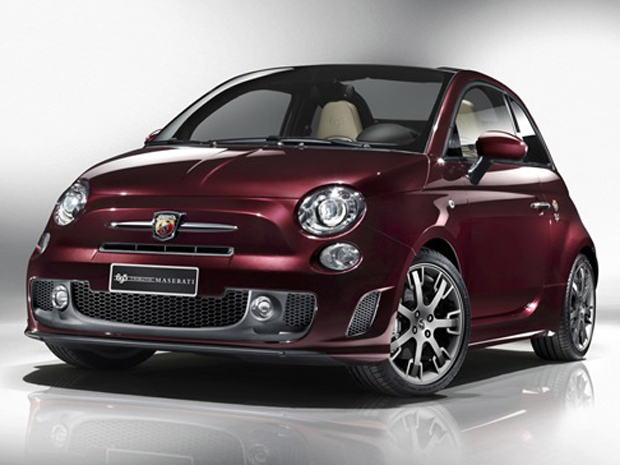

Planejando fazer uma renovação da marca durante o Salão de Frankfurt, a Abarth, braço direito e oficial da Fiat para carros preparados, apresentará 3 novidades no evento, dentre elas este Abarth 500 Cabrio Italia.
O carro compacto conversível faz uma homenagem aos 150 anos de unificação da Itália. Para isto, a série especial de exatamente 150 unidades traz exclusividades, tais como a cor Azul Abu Dhabi, vidros traseiros escurecidos, logotipos e detalhes cromados-acetinados e o motor 1.4 16v turbo TJet de 160 cavalos de potência e 23,5kgfm de torque. Em conjunto com uma caixa manual de 5 marchas, o carrinho acelera de 0 a 100km/h em apenas 7,4 segundos enquanto mantém um consumo médio de apenas 15,9km/l (ciclo europeu).
Outros mimos da versão comemorativa incluem kit de freios de performance da versão Esseesse (com pinças de 4 pistões pintadas de amarelo), faróis xenon, bancos concha da Sabelt revestidos em couro com costas em fibra de carbono, pedais e manopla de câmbio com efeito aluminizado, navegador GPS Blue&Me MAP com telemetria, capas dos retrovisores em cor magnésio e rodas aro 17 diamantadas.
Os outros carros da marca serão um 500 695 Competizione, com interior aliviado e motor de 180CV, e o Punto SuperSport com o mesmo motor.
Fonte: Abarth.


A concessão que o Brasileiro recebeu foi a adoção do motor flex, o 1.4 8v EVO de 88 cv e 12,5 kgfm de torque, usado pelo Uno, na versão Cult, que chega custando R$ 39.990 na versão manual e R$ 42.980 com câmbio automatizado Dualogic. Ainda assim a lista de equipamentos de série é inversamente proporcional às dimensões do 500.
A tal lista de equipamentos é composta por rodas de liga leve de 15 polegadas, freio ABS, airbag duplo, controle de estabilidade, controle de tração e Hill Holder, banco do motorista com regulagem de altura, faróis com regulagem elétrica, direção elétrica, sistema isofix para fixação de cadeirinhas, rádio com CD e MP3, vidros e travas elétricas, ar-condicionado manual, e volante com regulagem de altura.A vesão mais em conta do 500 em 2009, quando chegou, saía por R$ 62.870.
Os únicos opcionais são o pacote Convenience 1 (R$ 850), composto por piloto automático, volante multifunção em couro e sistema Blue&Me, e Sport (R$ 3.100) composto apenas pelo sistema de som Bose e teto solar elétrico.2.jpg”>
As outras versõs ou são novas ou trazem novidades. Fato é que todas compartilham de alterações feitas para atender às normas e gostos norte-americanos, como a inclusão de piscas nos paralamas (chamados side marks), modificações estruturais para melhorar o desempenho em impactos, suspensão com novas molas e amortecedores, e melhor conforto acústico.
O Sport ainda conta com para-choques esportivos, airbags laterais, piloto automático, rodas de 16 polegadas, faróis de neblina, freios com pinças vermelhas, saias laterais, spoiler traseiro, bancos parcialmente em couro e volante em couro, fora o novo motor 1.4 16v MultiAir de 105 cv e 13,4 kgfm de torqueque pode se associar ao câmbio automático, elevando o preço para R$ 54.800.
Com rodas são mais sóbrias, e visual semelhante ao do antigo 500 Lounge o modelo se difere por tem frisos cromados, retrovisores externos cromados e bancos com acabamento todo em couro, bem como o pomo do câmbio. Seu motor também é o 16v, mas está disponível apenas com câmbio automático de seis marchas da japonesa Aisin.
Para comemorar o relançamento do 500, a Fiat criou a série especial Prima Edizione, limitadissima a500 unidades numeradas. Elas serão oferecidas apenas nas cores vermelha, cinza e branca, sempre com interior cinza. Um logotipo estampado nas laterais e nos bancos identifica a série, junto a costura dos bancos em vermelho, rodas pintadas de preto e spoiler da mesma cor na tampa traseira.
Uma pessoa tinha uma revenda de carros á 20 anos atrás na Dinamarca, mas por algum motivo teve que fechá-la. Os carros ficaram guardados por anos la, grande parte zero quilômetro e agora o dono resolveu vender todos. São dezenas de raridades guardadas por décadas. Entre os carros estão Ladas, DKW Junior, Fiats 500, Fuscas, furgões…
Confira mais fotos dos carros:


Hop back to the distant (or not so distant) days of high school. Remember the complex universe that is class dynamics? Each class had its typical individuals. There was that all-around kind of guy. Perfect looks, perfect grades, perfect girlfriend. Maybe a little boring, but who cares when you can passionately discuss Fermat's last theorem at your own leisure?
Then there was the troublemaker: not exactly the sharpest knife in the drawer, but always a lot of fun to hang out with during sleepless nights. Not that your mom would approve.
But tucked away into the darkest, farthermost corner of the classroom was that quiet kid that could stay utterly silent for days, and when he finally had something to say, he murmured it a hushed tone that even the teacher ignored. This, believe it or not, brings us neatly into the subject of the new Fiat Bravo. Euro car buffs probably remember this nameplate from the late 1990s hatchback which replaced the fairly successful Fiat Tipo. The Bravo – and its five door sibling, the Brava – slotted in the family hatchback segment, and were replaced in 2001 by the Fiat Stilo.
The Stilo, to put it mildly, didn't exactly top the charts back in the Old Continent, and was criticized for its complete dullness. So after 6 years of declining sales, Fiat resurrected a nameplate from the turn of the century and drummed out a replacement: the new Fiat Bravo.

Funnily enough, this all-important VW Golf challenging car was developed in only 18 months, and used extensive computer simulation to speed things up. So, how does it all work out?
Well, for starters – no matter where you come from, this is car is a looker. Up front, the Bravo has the familiar Punto grille plastered on it and the back lights are influenced by the original Bravo. The overall shape is sleek and fluent – no design committees here. In a bid to avoid our daily allowance of Italian-car-related-clichés, we'll let you overview the rest. To our eyes, this is a win for Fiat's design studio, with clear influences from Fiat group's other offerings, such as the Alfa Romeo MiTo. However, our metallic-black tester didn't do the Bravo justice – this car aches for a bright color.
On another note, a closer look at the Bravo's wheel arches gave us the slight impression that it was a little more high-riding than we'd want. Or maybe it just needs a bigger set of wheels – the ones you see in the photos are a custom job by the dealer.
The interior is a revelation, speaking in Fiat terms. This is undoubtedly one of the best interiors the Italian company has ever produced to date, and we weren't even bothered by the fake carbon-fiber panels which felt fairly good to the touch. Most controls are logically arranged and there's orange ambient lighting all around. But wait, there's more: the door and trunk close with a reassuring thump that's been long missing from Fiat's midsize offerings.
Still, there are a few issues. Ask and thou shall find hard plastics where the eye doesn't see and even where it does – like in the gearlever area. The wiper and turning signal handles belong to the better part of the 1990s and there are not as many soft-touch areas as you'd find in some competitors. We could also see no good coming out of the partially reflective plastic covering the dials either, but the 
On the practicality front, the Bravo takes a few hits. The front seats feel a little awkward at first, but prove to be comfortable on long journeys – if a little hard. Rear legroom, however, is limited and you wouldn't want to place anyone you love in the middle rear seat. It could get nasty. The trunk itself isn't exceptionally big, but it's deep enough to comfortably fit an adult (don't ask).
Things get interesting under the bonnet. The gas engine range consists of 3 different states of tune of the same 1.4 liter, 16 valve unit – a naturally aspirated variant with 90 horsepower and two turbocharged versions, called T-JET, with 120 and 150 horsepower. If this all sounds familiar to you, it's because it is – this flexible little engine appears everywhere in the concern's offerings, including the Alfa MiTo and Abarth versions of the Punto and 500.
Unsurprisingly, Fiat's intention is to compete with Volkswagen on the small turbocharged engine front. Over the last two years, VW has been constantly replacing its lower capacity gas engines with smaller, turbocharged (and in some cases, supercharged as well) units, and Fiat has clearly spotted the advantage of the added torque and power availability.
Our tester was equipped with the mid-range motor, producing 120 horsepower. Consumers in the Holy Land – much like in the States – prefer their cars with two pedals only and without that odd stick to their right, so our tester was mated to a six-speed Dualogic sequential gearbox.
The first part of this combination impresses. 120 horsepower doesn't sound like much, and a sub-10-second sprint to 60 doesn't exactly rock the earth, but the flexibility of the turbo engine allows for excellent mid-range power. The spec sheet says that maximum torque is available from as low as 1,750 RPM – and thankfully, there's no noticeable turbo lag unless you really push it. As an added bonus, this engine has a great throaty sound and turbo hiss that's only noticeable if you open the window and concentrate. At which point you may put the Bravo's 5 star EuroNCAP crash test rating to review – be sure to let us know.

The Dualogic is simply not as smooth as a conventional automatic or a dual clutch gearbox like VW's DSG. And unlike the 500, the Bravo isn't equipped with any sort of a hill holding system (and there's no creeping), which means that the second you release the brake, the car will immediately succumb to the laws of physics and roll in the general direction of the gradient, which could coincide with the general direction of the car behind you. Possible solutions: growing a third leg or braking with your left foot, neither of which TTAC recommends.
To make matters worse, this autobox is hesitant and when it does finally decide on the proper gear it lets you know with a friendly kick. In town, it's a rocky and unpleasant experience. On the highway, it gets better. Here's the thing: if you drive this car like a regular automatic, you'll be disappointed. If you keep its manual roots in mind, lift off the throttle during upshifts and use the handy steering wheel mounted shifters, it's actually not an entirely traumatic experience – it even blips on downshifts. Which begs the question: why not get the manual (and save money) in the first place?
The ride leans to the harsh side. It's by no means uncomfortable, but slightly restless around town. On better roads it feels fairly composed, but wind noises intrude the cockpit in speeds approaching the legal limits.
When the roads got twisty, we had some expectations from the Bravo, as it comes from the company which has been producing sweet handling cars since the dawn of automotive time – not to mention owning Alfa Romeo, Ferrari, Maserati and Lancia. Coincidentally, this was also one of the most disappointing aspects of the Bravo.
There's the steering. The thick-rimmed leather wheel – which 
The Fiat Bravo isn'ta bad car. It's actually one of Fiat's best efforts to date: it's an attractive and fairly refined car with a worthy engine that's let down by disappointing driving dynamics and a poor automatic gearbox – though the latter is about to change with the introduction of Fiat's first dual clutch transmission (DCT) later this year. But it's still not as complete as the Volkswagen Golf or even the Ford Focus, and it suffers from Fiat's poor reputation when it comes to family hatchbacks.
The Bravo then, is that quiet student perched against the class wall. It can't be that awe-inspiring all-knowing guy – let's call him Golf – but neither can it be 'the dude' because of its mediocre driving dynamics and lack of driver appeal. And as quiet individuals go, it'll be ignored by most shoppers looking for a family hatchback – and that's a shame, because it still manages to be a refreshingly original pick in an otherwise boring class (pun unintended), that's also significantly cheaper than its more accomplished competitors. Bravo (sorry, we had to).
If you would like to know more about this vehicle, please contact us


Driven Wheels: Front
Gears: 6

Engine: 4 Cylinders In Line, 1368 Cc, Turbo Charged, DOHC


